
专门生产植绒拭子的制造商 & CHG产品.
肠道微生物组测试: 它是什么, 它是如何运作的, 以及为什么它很重要
2026-08-05
人类肠道是影响消化的数万亿微生物的家园, 免疫, 代谢, 甚至心理健康. 随着对肠道微生物组的研究不断扩大, 肠道微生物组检测 已成为研究人员越来越有价值的工具, 临床医生, 和医疗机构寻求更深入了解胃肠道健康.
在本文中, 我们将探讨什么是肠道微生物组测试, 它是如何运作的, 它的好处, 局限性, 以及为什么高质量的粪便样本采集对于获得可靠的结果至关重要.

什么是肠道微生物组测试?
肠道微生物组测试是一种实验室分析,用于检查胃肠道内的微生物. 使用粪便样本, 实验室可以识别和分析数千种细菌, 菌类, 病毒, 以及构成个体肠道微生物组的其他微生物.
与仅检测某些病原体的传统粪便培养不同, 现代微生物组测试利用先进的分子技术,例如:
- 16S rRNA基因测序
- 鸟枪法宏基因组测序
- 定量PCR (定量PCR)
- 全基因组测序 (全基因组测序)
这些方法使科学家能够更准确地了解肠道微生物的组成和多样性.
谁应该考虑肠道微生物组测试?
- 患有慢性消化不适的人
- 反复胃肠道感染患者
肠道微生物组测试如何进行?
步 1: 粪便样本采集
测试过程首先使用无菌采集套件采集粪便样本.
正确的收集至关重要,因为污染或储存不当会严重影响微生物分析.
高质量的收集套件应提供:
- 无菌采样拭子
- 收集管
- 样品保存解决方案 (适用时)
- 手套
- 收藏纸
- 生物危害运输袋
- 清晰的指示
步 2: 样品保存
收集的样品在运输过程中保持稳定以保存微生物 DNA.
适当的保存有助于维持微生物组成,直到实验室处理开始.
步 3: DNA提取
实验室从粪便样本中分离微生物 DNA.
步 4: 测序
取决于测试平台, DNA经历:
- 16S rRNA测序
- 宏基因组测序
- PCR扩增
步 5: 生物信息学分析
先进的软件可识别微生物种类并生成报告,其中可能包括:
- 微生物多样性
- 相对丰度
- 功能途径
- 群落组成
- 研究生物标志物
肠道微生物组测试可以揭示什么?
现代微生物组报告通常提供以下信息:
- 微生物多样性: 您的物种总体范围和平衡, 通常通过多样性指数进行评分.
- 主要分类群的比例: 有益细菌的水平 (喜欢 双歧杆菌 或者 阿克曼氏菌) 与破坏性或炎症性群体相比.
- 功能潜力: 深入了解微生物分解纤维并产生有用代谢物(如短链脂肪酸)的能力 (例如, 丁酸盐).
- 生态失调的特征: 与慢性症状相关的失衡, 最近使用抗生素, 或饮食压力.
为什么高质量样本采集很重要
微生物组测试的准确性早在 DNA 测序之前就已开始.
不良的收集技术可能会导致:
- 样品污染
- DNA降解
- 微生物回收率降低
- 测序结果不准确
为此原因, 实验室越来越多地选择专为微生物组分析设计的专业粪便收集系统.
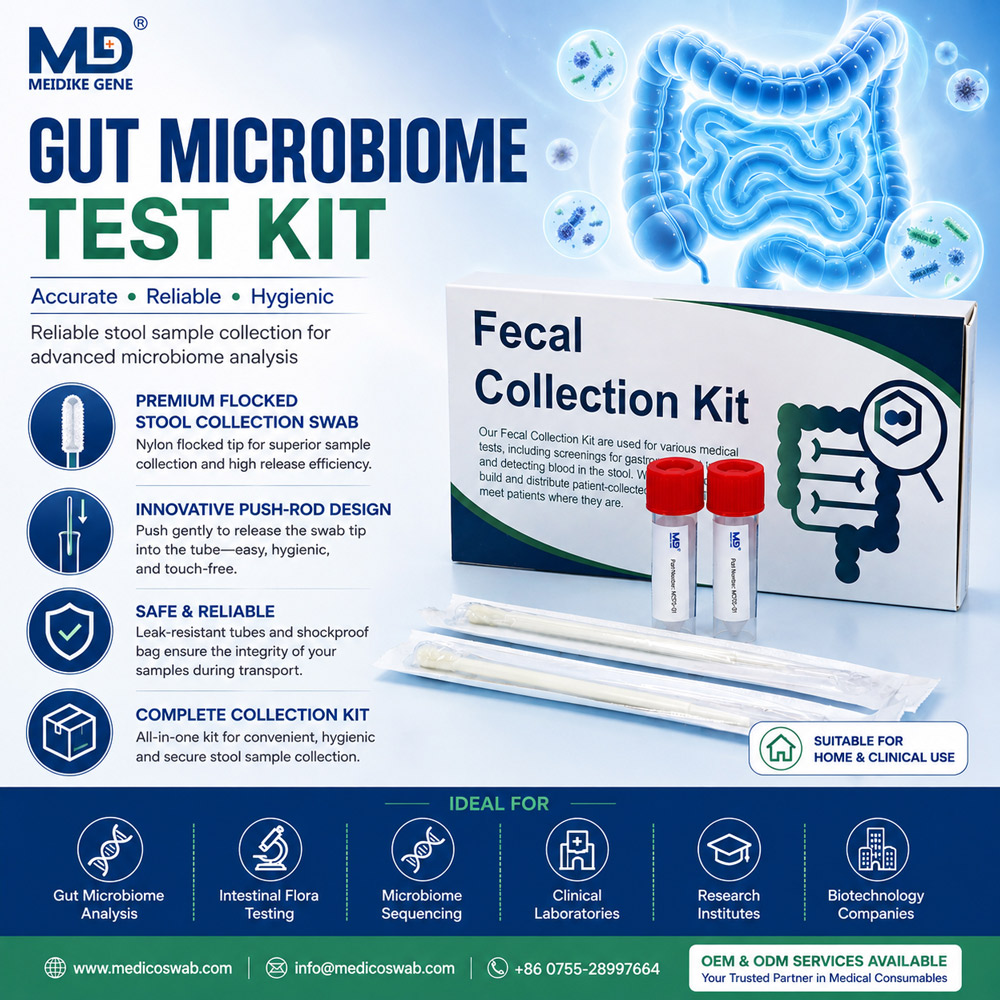
用于肠道微生物组测试的 MEIDIKE GENE 粪便采集套件
用于可靠的粪便样本采集, MEIDIKE GENE 提供专业的 粪便收集套件 专为研究实验室设计, 诊断中心, 以及OEM/ODM客户.
在这里探索产品:
也许你也喜欢

版权所有©2026. 医药科技有限公司, 有限责任公司